

The Real Cost of a Louisiana Wedding: A Photographer's Guide to Budgeting | Baton Rouge Photographer
If you've started pricing out venues, caterers, and florists for your Louisiana wedding, you've probably already had one of two reactions: relief that it's more affordable than what you've seen on wedding blogs written for New York or California brides, or shock that "affordable" still means tens of thousands of dollars. Both reactions are fair. After years spent photographing weddings from the French Quarter to the plantations along the River Road to backyard receptions in Acadiana, I've watched a lot of couples build a budget from scratch, and I've watched a lot of couples wish they'd done it differently. This guide is everything I wish every couple knew before they signed their first vendor contract.
What Louisiana Weddings Actually Cost
Wedding budgets get thrown around online without much context, so let's start with numbers that are actually grounded in Louisiana. Statewide, the average wedding runs around $36,000, just above the national average of roughly $34,000. But "statewide average" hides a lot, because cost varies enormously by region:
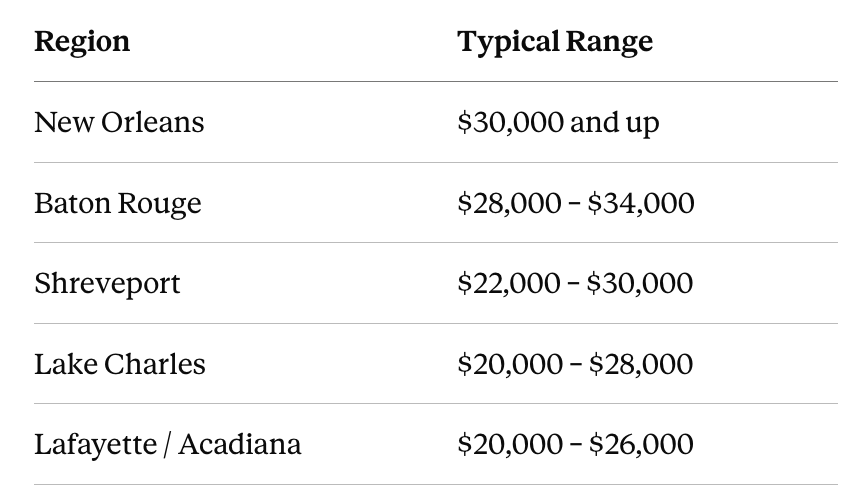
New Orleans carries a real premium. It's a destination market with a limited supply of historic venues, higher staffing costs, and pricing that reflects year-round tourism demand — a 125-person New Orleans wedding averages around $36,000, with venue rental alone often running about $12,000 of that. Acadiana, by contrast, tends to offer the most value in the state: couples there can often host a more elevated wedding, with better food and more personal touches, for what would only cover the basics in New Orleans. None of this means you have to spend at the average — plenty of beautiful, meaningful weddings happen well below these numbers. But it's useful to know where your market sits before you start comparing your quotes to a friend's wedding three parishes away.
If You're Planning a Luxury or Upscale Louisiana Wedding
The numbers above cover the typical Louisiana wedding, but if you're planning something more elaborate — a top-tier venue, a full planning team, live music for both ceremony and reception, upgraded florals and design, or a multi-day celebration for out-of-town guests — the budget looks different. Published data specific to the luxury tier is thinner than for the average wedding, but based on real venue and vendor pricing (a large full-service New Orleans venue alone can run $15,000–$25,000+, and a Saturday night in the French Quarter can hit $20,000+ for the venue by itself), here's a realistic range for an upscale wedding by region:
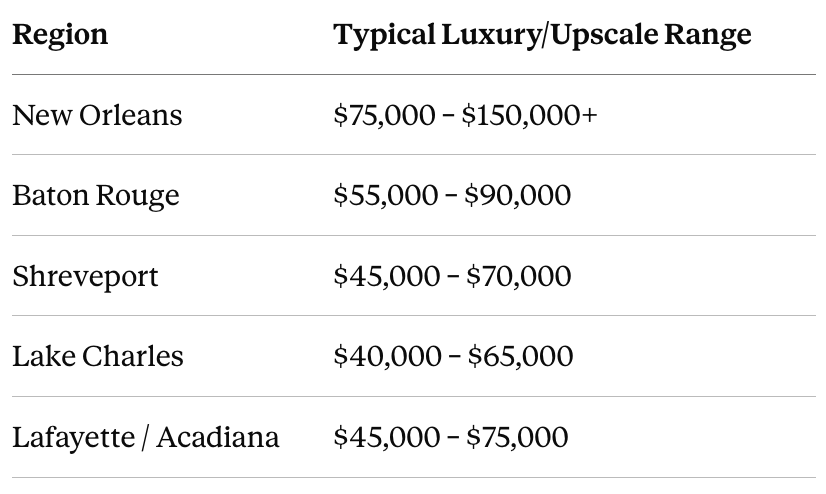
New Orleans again sits at the top of the state, driven by premium historic venues, a live band plus a second line, multi-day welcome parties and brunches, and full-service planning teams — couples here often push well into the upper five figures and beyond once tourism-driven pricing and guest counts of 150+ come into play. Take these as directional estimates rather than firm quotes — luxury pricing swings enormously with guest count, venue exclusivity, and time of year, so the right next step is getting personalized proposals from a small handful of high-end venues and planners once you have a sense of scale.
Where the Money Actually Goes
Every wedding is different, but most budgets break down along similar lines. As a rough guide:
Venue and catering together typically eat up 40–50% of the total budget — this is almost always the single biggest expense, especially in Louisiana, where food is not an afterthought.
Photography and videography combined usually run 10–15%.
Attire (dress, suit, alterations, accessories) tends to land around 8–10%.
Flowers and decor run another 8–10%.
Music and entertainment — DJ, band, or in New Orleans, often both a reception band and a second line — typically takes 8–10%.
The remainder gets split across invitations, hair and makeup, transportation, favors, and the catch-all "miscellaneous" category that always ends up bigger than anyone expects.
I'd encourage you to treat these as a starting framework, not a rulebook. If a live Cajun or brass band is non-negotiable for you, let that category grow and trim somewhere else. The couples who end up happiest with their budget are the ones who decided early what actually mattered to them and gave themselves permission to spend less everywhere else.
Louisiana Line Items Out-of-State Budget Guides Won't Mention
Most wedding budgeting articles are written with a generic American wedding in mind, and they miss several costs that are specifically Louisiana:
Second line bands. If you're planning a New Orleans wedding with a second line, budget for it as its own line item, separate from your reception band. Bands are typically hired for a set fee, and it's customary to hand the bandleader a cash tip on the spot at the end — plan for that cash to be ready in an envelope before the wedding day, because no one wants to be running to an ATM mid-reception.
Hurricane season and wedding insurance. Louisiana's wedding season overlaps heavily with hurricane season, which runs June through November. Event insurance that covers cancellation or postponement due to a storm is inexpensive relative to what it protects, and it's one of the few line items I'd call close to non-negotiable if your date falls between June and October.
A real indoor backup plan. Between the heat, the humidity, and the chance of an afternoon downpour, an outdoor Louisiana wedding needs a legitimate covered backup, not a tent thrown up as an afterthought. Ask your venue exactly what their rain plan looks like and what it costs, before you fall in love with the oak-alley photos.
Marriage license and waiting period. A Louisiana marriage license generally costs somewhere in the $30–$60 range depending on the parish, is valid statewide, and comes with a short waiting period (often 24 to 72 hours) before the ceremony, though many parishes offer a waiver for a small additional fee. Costs and exact rules vary by parish, so confirm directly with your parish's Clerk of Court — it's a small cost, but couples occasionally forget to budget the time, not just the money.
Church and officiant stipends. Louisiana has a large share of Catholic ceremonies, and a stipend to the parish (often a few hundred dollars) is standard on top of any officiant fee, particularly if you're marrying outside your home parish.
Parking, valet, and permits. French Quarter and historic downtown venues frequently require paid parking or valet service for guests, and outdoor ceremonies in public spaces like City Park or Audubon Park may require a permit. These are easy to miss when you're comparing venue rental fees at face value.
Out-of-town guest logistics. If you're marrying in New Orleans, Lafayette during festival season, or anywhere with a strong tourism pull, hotel room blocks fill up and get pricier the closer you get to peak season (Mardi Gras, Jazz Fest, and festival weekends especially). Booking blocks early can save your guests — and sometimes you — real money.
Where Photography Fits Into the Budget
I'll be honest with you, because that's more useful than a sales pitch: photography and videography together typically run 10–15% of a Louisiana wedding budget, and within that, photography alone is often somewhere in the $3,000–$6,000+ range depending on coverage hours, second shooters, and albums. It's easy to look at that number next to a catering quote and want to trim it first, since a smaller cake or simpler flowers won't be the thing you notice in twenty years — but your photos will be the only part of the day you can still hold in your hands.
If you do need to adjust the photography line, there are better and worse ways to do it. Trimming coverage hours or skipping a second shooter costs you less than picking a photographer purely on price, because inexperienced photographers in a humid, high-contrast environment like Louisiana — deep shade under oak trees, bright reflections off the water, low light in old brick venues — often turn in results that don't hold up. It's worth protecting the line item even if you shrink it elsewhere.
A Sample $30,000 Louisiana Wedding Budget
To make this concrete, here's roughly how a $30,000 budget might break down for a mid-sized Louisiana wedding (adjust up or down for your region and guest count):
Venue and catering: $13,500.
Photography and videography: $3,750.
Attire: $2,700.
Flowers and decor: $2,700.
Music and entertainment: $2,700.
Hair and makeup: $900.
Invitations and paper goods: $600.
Transportation: $600.
Wedding insurance: $250.
Marriage license and officiant stipend: $300.
Miscellaneous and contingency: $2,000.
That contingency line matters more than any other number on this list. Something unplanned always comes up — an extra alteration, a last-minute rental, a vendor gratuity you hadn't accounted for — and having 5–7% of your budget held in reserve is the difference between a small surprise and a stressful one.
A Sample $50,000 Louisiana Wedding Budget
A $50,000 budget usually isn't just a bigger version of the $30,000 wedding — it's where couples typically add a day-of or partial planner and stop trying to DIY every detail themselves, and where photography coverage tends to stretch to a full day with both a photographer and videographer. Here's a realistic breakdown:
Venue and catering: $21,200.
Photography and videography: $6,500.
Flowers and decor: $4,500.
Attire: $4,000.
Music and entertainment: $4,500.
Wedding planner or day-of coordinator: $2,500.
Hair and makeup: $1,400.
Invitations and stationery: $1,000.
Transportation: $1,000.
Wedding insurance: $400.
Marriage license and officiant stipend: $500.
Miscellaneous and contingency: $2,500.
A Sample $100,000 Louisiana Wedding Budget
At $100,000, the budget usually isn't just scaling up the same categories — new categories tend to appear altogether: a full-service wedding planner rather than just day-of coordination, a welcome party or rehearsal dinner contribution, upgraded design elements like specialty lighting and draping, and photography/videography packages that include an engagement session, a second shooter, and a proper album. A sample breakdown:
Venue and catering: $41,000.
Photography and videography: $12,000.
Flowers, decor, and design (lighting and draping): $9,000.
Attire: $7,000.
Music and entertainment: $9,000.
Full-service wedding planner: $6,000.
Welcome party or rehearsal dinner contribution: $3,000.
Hair and makeup: $2,500.
Invitations and stationery: $2,000.
Transportation: $2,000.
Wedding insurance: $600.
Marriage license and officiant stipend: $600.
Miscellaneous and contingency: $5,300.
Whatever your total budget, the categories stay roughly the same — it's really the depth of coverage, the level of design, and how much you're paying other people to manage logistics for you that shifts as the number grows.
A Few Practical Ways to Save Without Feeling Like You're Cutting Corners
Marry on a Friday or Sunday, or in the shoulder months (January–February or August, avoiding the Mardi Gras and festival calendar crunch in south Louisiana) — venues and caterers often price these dates noticeably lower than a Saturday in October. Choose a venue that doubles as your ceremony and reception space, which cuts transportation costs and often a second rental fee. Ask every vendor directly what's included versus what's an add-on before you compare quotes — a lower-looking number sometimes hides rental fees, cake-cutting fees, or overtime charges that make it not actually cheaper. And build your guest list before you build your budget, not after; guest count drives catering, rentals, invitations, and favors more than almost any other decision you'll make.
The Bottom Line
A wedding budget isn't really about the total number — it's about deciding, on purpose, what you and your partner actually want people to remember about your day, and then funding that on purpose too. Louisiana gives you a wide range of ways to do that, from an elegant Garden District ballroom to a barn wedding in Acadiana to a backyard crawfish boil reception, and the right budget is the one that matches the wedding you actually want, not the one pulled from a national survey.
If you're in the early planning stages and want to talk through how photography coverage fits into your specific budget and timeline, I'd love to hear about your day — reach out any time.
Sarah Shaw is a Baton Rouge photographer specializing in weddings, families, and seniors — drawn to natural light, genuine connection, and the quiet in-between moments that mean the most.